
One-Step vs Two-Step Blow Molding: Which Is Better?: Practical Technical Guide
For One-Step vs Two-Step Blow Molding: Which Is Better?, the objective is not to find one universal setting. It is to prove which combination of process architecture, surface and handling quality, and maintenance organization produces the required bottle under stable factory conditions.
Process architectureTooling strategyDecision rule
Was dieser Artikel beweisen muss
Decide whether resin-to-bottle one-step isbm or separate preform and reheat blow molding better fits the packaging business. A defensible baseline begins with One-step ISBM injection-molds the preform and stretch-blows it within one integrated process, while two-step production separates preform manufacture from reheating and blowing. The first verification method is Map every operation from resin receiving to finished bottle and count transfers, intermediate storage and reheating stages. From there, the article follows only checks that can materially change the answer promised by the title. Where an exact operating value depends on the resin grade, bottle drawing, mold, or delivered machine, the approved project specification controls the final setting.
✔️ Process architecture
One-step ISBM injection-molds the preform and stretch-blows it within one integrated process, while two-step production separates preform manufacture from reheating and blowing. Map every operation from resin receiving to finished bottle and count transfers, intermediate storage and reheating stages.
✔️ Preform heat history
One-step molding can use heat retained from injection and condition the preform before blowing; two-step reheats a cooled preform. Compare how each route creates the axial and circumferential temperature profile needed for the bottle.
✔️ Surface and handling quality
One-step systems can avoid bulk preform storage and feeding, while two-step systems depend on preform conveying, orientation and reheating. For appearance-critical packs, trace every contact point that can scratch or contaminate the preform or neck.
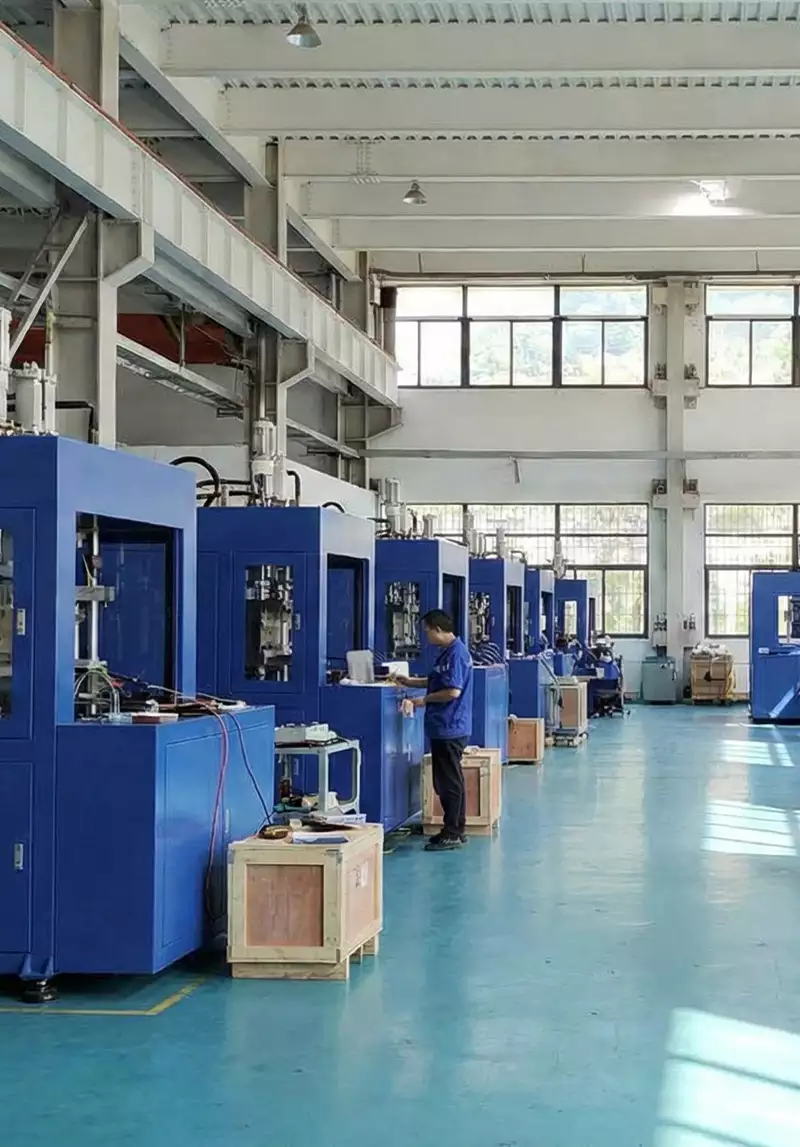
Bei der Umsetzung der Anforderungen in Hardware, HGY50-V3-EV-Maschinenkonfiguration veranschaulicht, wie Einspritzen, thermische Konditionierung, Streckblasbewegung und Handhabung auf einer kompakten Ein-Schritt-Plattform organisiert sind.
Process Flow: Where the Two Routes Differ
Process architecture
Process architecture. One-step ISBM injection-molds the preform and stretch-blows it within one integrated process, while two-step production separates preform manufacture from reheating and blowing. Map every operation from resin receiving to finished bottle and count transfers, intermediate storage and reheating stages. Compare both options against the same bottle geometry, resin, good-output target, and quality criteria when judging process architecture. This factor belongs in the setup sheet because it directly changes the conditions under which process architecture is evaluated. Ignoring intermediate handling makes two processes look more similar than they are.
Quality and Handling Consequences
Preform heat history
Preform heat history. One-step molding can use heat retained from injection and condition the preform before blowing; two-step reheats a cooled preform. Compare how each route creates the axial and circumferential temperature profile needed for the bottle. Compare both options against the same bottle geometry, resin, good-output target, and quality criteria when judging preform heat history. If the result differs by cavity, compare the local hardware related to preform heat history before moving on to preform heat history. A poor thermal profile causes local over-stretch, haze, pearlescence or weak material distribution regardless of machine type.
Surface and handling quality
Surface and handling quality. One-step systems can avoid bulk preform storage and feeding, while two-step systems depend on preform conveying, orientation and reheating. For appearance-critical packs, trace every contact point that can scratch or contaminate the preform or neck. Compare both options against the same bottle geometry, resin, good-output target, and quality criteria when judging surface and handling quality. This item is considered resolved only when the finding remains repeatable after thermal stabilization and the next check, surface and handling quality, does not contradict it. Premium cosmetic bottles may reject defects that are acceptable on commodity beverage bottles.
When Production Volume Changes the Answer
Volume economics
Volume economics. Two-step systems can separate very high-volume preform production from high-speed blow molding; one-step can reduce intermediate equipment for direct bottle production. Build cost per good bottle at the required annual volume, including tooling, utilities, labor, inventory and changeovers. Compare both options against the same bottle geometry, resin, good-output target, and quality criteria when judging volume economics. For repeatability, define who measures volume economics, where it is measured, and what bottle evidence is required before checking volume economics. Using only machine purchase price hides the economics created by scale and product mix.
Arbeitsbedingungen für diese spezifische Aufgabe
- Process architecture
- One-step ISBM injection-molds the preform and stretch-blows it within one integrated process, while two-step production separates preform manufacture from reheating and blowing.
- Preform heat history
- One-step molding can use heat retained from injection and condition the preform before blowing; two-step reheats a cooled preform.
- Surface and handling quality
- One-step systems can avoid bulk preform storage and feeding, while two-step systems depend on preform conveying, orientation and reheating.
- Volume economics
- Two-step systems can separate very high-volume preform production from high-speed blow molding; one-step can reduce intermediate equipment for direct bottle production.
Tooling, Inventory and Changeover Trade-Offs
Product variety
Product variety. One-step systems are often chosen for varied shapes, wide-mouth containers, thick-wall appearance and specialty resins; two-step systems excel when standardized preforms feed multiple blowing lines. Count bottle families and determine whether they can share a preform design or require unique injection tooling. Compare both options against the same bottle geometry, resin, good-output target, and quality criteria when judging product variety. Record the bottle response beside the setting or measurement for product variety; that record becomes the starting condition when product variety is reviewed. Excessive preform variety can erase the inventory benefits of a two-step platform.
Tooling strategy
Tooling strategy. One-step projects coordinate injection, lip/neck, conditioning and blow tooling, while two-step operations may standardize preforms and change blow molds more independently. Estimate the number of tool sets needed over the product portfolio and how frequently they change. Compare both options against the same bottle geometry, resin, good-output target, and quality criteria when judging tooling strategy. If the symptom or performance target does not move as predicted, return tooling strategy to the baseline and investigate tooling strategy rather than stacking corrections. A portfolio with many low-volume SKUs can be dominated by tooling and changeover cost.
Der ASB-kompatible Werkzeugkonfiguration ist auch relevant, wenn geprüft werden muss, ob die Schnittstellen der Form und die Maschinenbewegung bei Austausch, Fehlersuche oder Kapazitätsänderungen kompatibel bleiben müssen.
| Artikel | Ingenieurfrage | Praktische Überprüfung |
|---|---|---|
| Process architecture | One-step ISBM injection-molds the preform and stretch-blows it within one integrated process, while two-step production separates preform manufacture from reheating and blowing. | Map every operation from resin receiving to finished bottle and count transfers, intermediate storage and reheating stages. |
| Preform heat history | One-step molding can use heat retained from injection and condition the preform before blowing; two-step reheats a cooled preform. | Compare how each route creates the axial and circumferential temperature profile needed for the bottle. |
| Surface and handling quality | One-step systems can avoid bulk preform storage and feeding, while two-step systems depend on preform conveying, orientation and reheating. | For appearance-critical packs, trace every contact point that can scratch or contaminate the preform or neck. |
| Volume economics | Two-step systems can separate very high-volume preform production from high-speed blow molding; one-step can reduce intermediate equipment for direct bottle production. | Build cost per good bottle at the required annual volume, including tooling, utilities, labor, inventory and changeovers. |
| Product variety | One-step systems are often chosen for varied shapes, wide-mouth containers, thick-wall appearance and specialty resins; two-step systems excel when standardized preforms feed multiple blowing lines. | Count bottle families and determine whether they can share a preform design or require unique injection tooling. |
| Tooling strategy | One-step projects coordinate injection, lip/neck, conditioning and blow tooling, while two-step operations may standardize preforms and change blow molds more independently. | Estimate the number of tool sets needed over the product portfolio and how frequently they change. |
| Freigabebedingung | Choose by product mix, annual volume, appearance, materials, inventory philosophy, available space and organization capability. Use a weighted matrix with mandatory requirements and cost-per-good-container scenarios. | |
Material and Container Flexibility
Inventory and logistics
Inventory and logistics. Two-step production may store and transport preforms; one-step moves material continuously from pellet to bottle. Measure warehouse space, preform packaging, contamination controls and internal logistics rather than treating inventory as free. Compare both options against the same bottle geometry, resin, good-output target, and quality criteria when judging inventory and logistics. If a change improves one region but worsens another, compare the material or energy movement between inventory and logistics and inventory and logistics instead of accepting the first visual improvement. Large preform buffers add working capital and handling risk but can also decouple molding and blowing schedules.
Utilities, Labor and Floor-Space Effects
Utilities and energy flow
Utilities and energy flow. Both routes need resin preparation, cooling and compressed air, but the distribution of heating and machine loads differs. Compare actual proposed system utility loads at the target bottle, including compressors, dryers, chillers and ovens where used. Compare both options against the same bottle geometry, resin, good-output target, and quality criteria when judging utilities and energy flow. Where the outcome depends on material grade or tooling geometry, confirm the approved project limit and then use utilities and energy flow as the next cross-check. Generic energy claims are unreliable unless the full system boundary is defined.
Maintenance organization
Maintenance organization. One-step concentrates injection and blowing technology in one machine; two-step separates specialized assets. Evaluate technician skills, spare parts, maintenance windows and whether one failure stops the whole bottle-making chain. Compare both options against the same bottle geometry, resin, good-output target, and quality criteria when judging maintenance organization. When the project is near a machine or material limit, require a molding trial that isolates maintenance organization and then challenges maintenance organization under the same bottle specification. Integrated equipment simplifies material flow but can concentrate downtime risk.
Decision Matrix: Choose the Route that Fits the Plant
Decision rule
Decision rule. Choose by product mix, annual volume, appearance, materials, inventory philosophy, available space and organization capability. Use a weighted matrix with mandatory requirements and cost-per-good-container scenarios. Compare both options against the same bottle geometry, resin, good-output target, and quality criteria when judging decision rule. The safest interpretation comes from comparing at least several stable cycles and then verifying decision rule without changing the rest of the recipe. There is no universally better route; the wrong choice usually comes from optimizing one metric while ignoring the plant system.
Maintenance organization: release evidence
One-step concentrates injection and blowing technology in one machine; two-step separates specialized assets. Evaluate technician skills, spare parts, maintenance windows and whether one failure stops the whole bottle-making chain. The condition is accepted only when the relevant bottle measurement or functional test remains stable after the process reaches normal operating temperature.
Decision rule: failure boundary
There is no universally better route; the wrong choice usually comes from optimizing one metric while ignoring the plant system. Use that failure mode as the boundary for the trial and return to the previous stable condition when the bottle response moves in the wrong direction.
For a compatibility check, the ASB-12 blow mold compatibility shows the kinds of mechanical and thermal interfaces that should be verified before a tooling or process change is released to production.
Questions that arise specifically in One-Step vs Two-Step Blow Molding: Which Is Better?
Is one-step ISBM more energy efficient?
It can avoid a separate preform reheating stage, but the correct comparison is total system energy for the same good-bottle output, including injection, drying, cooling and compressed air.
Which route is better for cosmetic packaging?
One-step production is often attractive for appearance-sensitive and unusual containers because it integrates preform and bottle molding, but the final choice depends on resin, shape, volume and surface requirements.
Which route is better for very high bottle volume?
High-volume standardized packaging often favors specialized high-throughput preform and blow systems, but a project should be modeled using actual annual demand and line utilization.
Can two-step systems use the same preform for several bottles?
Often yes when neck finish and stretch geometry allow it. The shared preform must still provide an acceptable thermal and material-distribution window for every bottle.
Does one-step eliminate all storage?
It eliminates the need to store intermediate preforms in the same way as a two-step route, but resin, molds, packaging materials and finished bottles still require planned storage.
Praktische Schlussfolgerung
The final decision on One-Step vs Two-Step Blow Molding: Which Is Better? is made by the bottle, not by a single displayed parameter. Use process architecture to establish the input, tooling strategy to test the mechanism, and decision rule to prove the output under stable conditions. There is no universally better route; the wrong choice usually comes from optimizing one metric while ignoring the plant system.