
Can ISBM Machines Process PETG and PCTG?: Practical Technical Guide
For Can ISBM Machines Process PETG and PCTG?, the objective is not to find one universal setting. It is to prove which combination of grade identity, drying, and end-use validation produces the required bottle under stable factory conditions.
Grade identityStretch timingChangeover
What this article must prove
Determine whether a particular isbm machine, tooling and process can handle petg or pctg copolyesters without assuming that pet settings or all copolyester grades are interchangeable. A defensible baseline begins with PETG and PCTG are families of copolyesters with grade-specific viscosity, crystallization behavior and intended conversion methods. The first verification method is Obtain the technical data for the exact grade and confirm it is recommended for injection stretch blow molding. From there, the article follows only checks that can materially change the answer promised by the title. Where an exact operating value depends on the resin grade, bottle drawing, mold, or delivered machine, the approved project specification controls the final setting.
✔️ Grade identity
PETG and PCTG are families of copolyesters with grade-specific viscosity, crystallization behavior and intended conversion methods. Obtain the technical data for the exact grade and confirm it is recommended for injection stretch blow molding.
✔️ Machine plasticizing
Check barrel temperature capability, screw design, shot size and residence-time control against the grade processing window. Review the supplier startup guidance and avoid leaving heat-sensitive material stationary in the barrel longer than necessary.
✔️ Drying
Many copolyesters are moisture-sensitive during melt processing and require controlled drying. Use grade-specific drying conditions and protect dried material during conveying.
For tooling-related decisions, the ASB-12 replacement mold engineering highlights why dimensional interfaces, cooling connections, cavity geometry, and transfer alignment must be treated as part of the machine setup.
First Confirm the Exact Copolyester Grade
Grade identity
Grade identity. PETG and PCTG are families of copolyesters with grade-specific viscosity, crystallization behavior and intended conversion methods. Obtain the technical data for the exact grade and confirm it is recommended for injection stretch blow molding. For grade identity, confirm the exact resin grade and intended conversion route before borrowing settings from another polymer family. Where the outcome depends on material grade or tooling geometry, confirm the approved project limit and then use grade identity as the next cross-check. A resin name alone is not enough to establish process compatibility.
Check Whether the Grade Is Intended for ISBM
Machine plasticizing
Machine plasticizing. Check barrel temperature capability, screw design, shot size and residence-time control against the grade processing window. Review the supplier startup guidance and avoid leaving heat-sensitive material stationary in the barrel longer than necessary. For machine plasticizing, confirm the exact resin grade and intended conversion route before borrowing settings from another polymer family. When the project is near a machine or material limit, require a molding trial that isolates machine plasticizing and then challenges machine plasticizing under the same bottle specification. A machine that processes PET can still create excessive residence or shear for a different copolyester.
Review Drying and Melt Preparation
Drying
Drying. Many copolyesters are moisture-sensitive during melt processing and require controlled drying. Use grade-specific drying conditions and protect dried material during conveying. For drying, confirm the exact resin grade and intended conversion route before borrowing settings from another polymer family. The safest interpretation comes from comparing at least several stable cycles and then verifying drying without changing the rest of the recipe. Moisture-related degradation can appear as reduced toughness, bubbles, haze or unstable processing.
Preform cooling
Preform cooling. Copolyester crystallization and softening behavior can differ from PET. Adjust injection cooling and transfer temperature so the preform is stable yet stretchable. For preform cooling, confirm the exact resin grade and intended conversion route before borrowing settings from another polymer family. A useful production trial keeps the resin lot and cavity identification fixed while preform cooling is changed, followed by a separate check of preform cooling. A PET cooling schedule may create sticking or an unsuitable blow temperature.
Working terms for this specific task
- Grade identity
- PETG and PCTG are families of copolyesters with grade-specific viscosity, crystallization behavior and intended conversion methods.
- Machine plasticizing
- Check barrel temperature capability, screw design, shot size and residence-time control against the grade processing window.
- Drying
- Many copolyesters are moisture-sensitive during melt processing and require controlled drying.
- Preform cooling
- Copolyester crystallization and softening behavior can differ from PET.
Rebuild the Thermal Conditioning Window
Conditioning
Conditioning. Map the axial and circumferential temperature needed for the target bottle rather than copying a PET recipe. Use small controlled changes and verify wall thickness and surface appearance. For conditioning, confirm the exact resin grade and intended conversion route before borrowing settings from another polymer family. The practical value of this check is that it turns conditioning from a vague setting into evidence that can be compared with conditioning. An overly hot preform can sag or mark; an overly cold one can resist stretch and create stress whitening.
| مورد | Engineering question | Practical verification |
|---|---|---|
| Grade identity | PETG and PCTG are families of copolyesters with grade-specific viscosity, crystallization behavior and intended conversion methods. | Obtain the technical data for the exact grade and confirm it is recommended for injection stretch blow molding. |
| Machine plasticizing | Check barrel temperature capability, screw design, shot size and residence-time control against the grade processing window. | Review the supplier startup guidance and avoid leaving heat-sensitive material stationary in the barrel longer than necessary. |
| Drying | Many copolyesters are moisture-sensitive during melt processing and require controlled drying. | Use grade-specific drying conditions and protect dried material during conveying. |
| Preform cooling | Copolyester crystallization and softening behavior can differ from PET. | Adjust injection cooling and transfer temperature so the preform is stable yet stretchable. |
| Conditioning | Map the axial and circumferential temperature needed for the target bottle rather than copying a PET recipe. | Use small controlled changes and verify wall thickness and surface appearance. |
| Stretch timing | Rod speed, start position and pre-blow timing must match the grade extension behavior. | Tune with thickness mapping and base/shoulder inspection. |
| Release condition | Define purge, cleaning and material-segregation steps when switching between PET and copolyesters. Prevent mixed resin from entering the next production lot and record the validated recipe by grade. | |
Adapt Stretch and Blow Timing
Stretch timing
Stretch timing. Rod speed, start position and pre-blow timing must match the grade extension behavior. Tune with thickness mapping and base/shoulder inspection. For stretch timing, confirm the exact resin grade and intended conversion route before borrowing settings from another polymer family. Use this result to narrow the process window, not to create a new universal setpoint; the next constraint to confirm is stretch timing. Aggressive timing borrowed from another resin can cause local thinning or base failure.
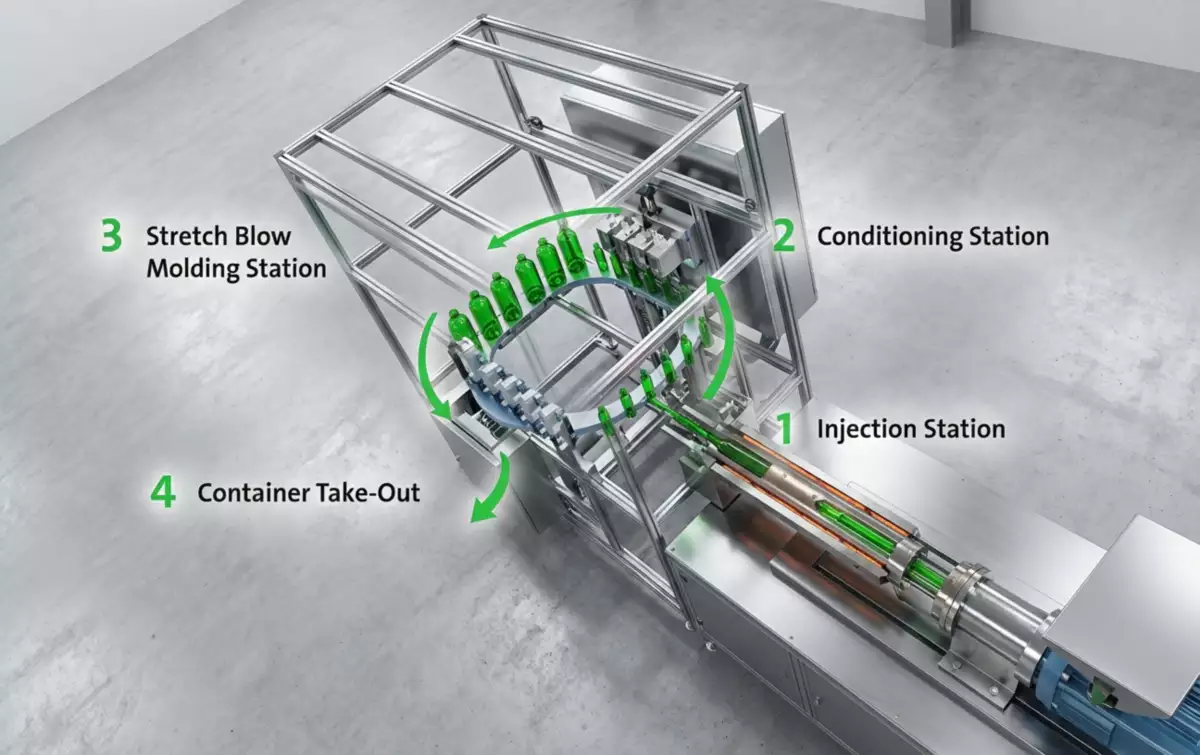
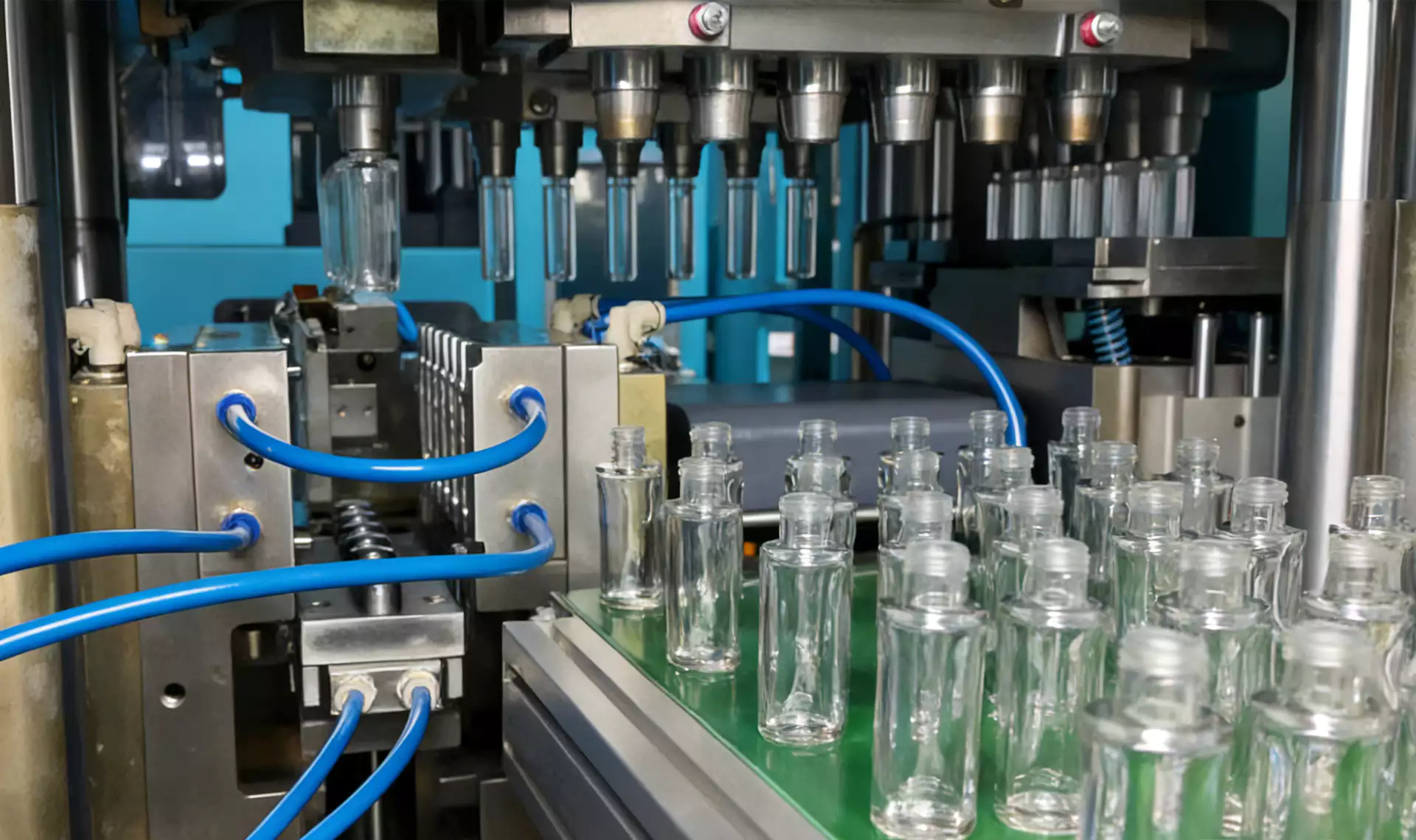
When translating the requirement into hardware, the HGY50-V3-EV machine configuration illustrates how injection, thermal conditioning, stretch-blow motion, and handling are organized on a compact one-step platform.
Check Mold Cooling and Release
Blow pressure
Blow pressure. Use only the pressure needed for complete forming within the material and machine process window. Check detail reproduction, wall stress and venting before increasing pressure. For blow pressure, confirm the exact resin grade and intended conversion route before borrowing settings from another polymer family. The expected response should be visible in a bottle measurement, defect map, or machine trend before the team proceeds to blow pressure. High pressure cannot compensate for a poor thermal or stretch profile.
Mold release
Mold release. Surface finish, draft, cooling and part ejection should be reviewed for the selected copolyester. Run sustained trials and inspect for sticking, scuffing or distortion at removal. For mold release, confirm the exact resin grade and intended conversion route before borrowing settings from another polymer family. Once this check is stable, the next useful question is whether mold release changes the same bottle region or affects a different part of the process. A bottle that molds once may not release reliably after the mold reaches steady temperature.
Validate Appearance, Chemical Resistance and Downstream Use
End-use validation
End-use validation. Copolyesters are often chosen for clarity, toughness or chemical resistance, but package performance must be tested with the actual product. Run drop, leak, environmental stress, cosmetic and storage tests appropriate to the application. For end-use validation, confirm the exact resin grade and intended conversion route before borrowing settings from another polymer family. This checkpoint should be evaluated before end-use validation is altered, because otherwise two process mechanisms change at the same time. Good molding behavior does not guarantee compatibility with fragrances, oils or sanitizing chemicals.
Create a Grade-Specific Recipe and Changeover Plan
Changeover
Changeover. Define purge, cleaning and material-segregation steps when switching between PET and copolyesters. Prevent mixed resin from entering the next production lot and record the validated recipe by grade. For changeover, confirm the exact resin grade and intended conversion route before borrowing settings from another polymer family. For this topic, the engineering log should connect changeover with the observed bottle condition and then test whether changeover supports the same diagnosis. Cross-contamination can alter clarity, color and recycling classification.
End-use validation: release evidence
Copolyesters are often chosen for clarity, toughness or chemical resistance, but package performance must be tested with the actual product. Run drop, leak, environmental stress, cosmetic and storage tests appropriate to the application. The condition is accepted only when the relevant bottle measurement or functional test remains stable after the process reaches normal operating temperature.
Changeover: failure boundary
Cross-contamination can alter clarity, color and recycling classification. Use that failure mode as the boundary for the trial and return to the previous stable condition when the bottle response moves in the wrong direction.
The ASB-12 injection tooling replacement is a useful equipment example when the task involves mold exchange, dimensional matching, cooling performance, or repeatable transfer between ISBM stations.
Questions that arise specifically in Can ISBM Machines Process PETG and PCTG?
Can any PETG grade be stretch blow molded?
No. Confirm that the exact grade is intended for ISBM or the required bottle process before committing tooling.
Can I use my PET temperature recipe?
Not as a default. PETG and PCTG grades can have different melt, cooling and stretch behavior, so build a grade-specific process window.
Do PETG and PCTG need drying?
Many copolyesters are moisture-sensitive in melt processing. Follow the resin supplier drying guidance for the specific grade.
Why does the bottle stick in the mold?
Check mold temperature, cooling balance, surface finish, draft, material temperature and ejection timing before changing several settings at once.
What should a compatibility trial prove?
Stable automatic molding, wall distribution, appearance, dimensions, release, downstream handling and end-use performance with the intended resin lot.
Practical conclusion
The final decision on Can ISBM Machines Process PETG and PCTG? is made by the bottle, not by a single displayed parameter. Use grade identity to establish the input, stretch timing to test the mechanism, and changeover to prove the output under stable conditions. Cross-contamination can alter clarity, color and recycling classification.