
3-Station vs 4-Station ISBM Machines Explained: Practical Technical Guide
This guide treats 3-Station vs 4-Station ISBM Machines Explained as a sequence of measurable decisions. It begins with the physical product requirement, then tests the process mechanisms that can change the bottle, and finishes with a release condition that can be documented.
Station sequenceTooling contentDecision test
What this article must prove
Understand what an added conditioning station changes in a one-step isbm cycle and when 3-station or 4-station architecture is the more practical choice. A defensible baseline begins with A typical 3-station layout combines injection, stretch-blow and ejection, while a 4-station layout adds a dedicated thermal conditioning position between injection and blowing. The first verification method is Ask the builder for the actual rotary sequence because names and station functions can differ by machine design. From there, the article follows only checks that can materially change the answer promised by the title. Where an exact operating value depends on the resin grade, bottle drawing, mold, or delivered machine, the approved project specification controls the final setting.
✔️ Station sequence
A typical 3-station layout combines injection, stretch-blow and ejection, while a 4-station layout adds a dedicated thermal conditioning position between injection and blowing. Ask the builder for the actual rotary sequence because names and station functions can differ by machine design.
✔️ Conditioning control
A dedicated station provides extra opportunity to redistribute or stabilize preform temperature before stretching. Review what the station controls: core temperature, external heating or cooling, neck protection, preferential heating or other conditioning hardware.
✔️ Residual heat use
Both architectures can use injection heat, but the time and path between injection and blowing differ. Track preform surface and internal temperature through the cycle rather than judging only one measured surface point.
For tooling-related decisions, the ASB-12 replacement mold engineering highlights why dimensional interfaces, cooling connections, cavity geometry, and transfer alignment must be treated as part of the machine setup.
What Each Station Actually Does
Station sequence
Station sequence. A typical 3-station layout combines injection, stretch-blow and ejection, while a 4-station layout adds a dedicated thermal conditioning position between injection and blowing. Ask the builder for the actual rotary sequence because names and station functions can differ by machine design. Compare both options against the same bottle geometry, resin, good-output target, and quality criteria when judging station sequence. When the project is near a machine or material limit, require a molding trial that isolates station sequence and then challenges station sequence under the same bottle specification. Assuming every 3- or 4-station machine behaves identically can lead to wrong process expectations.
Thermal Conditioning: The Main Architectural Difference
Conditioning control
Conditioning control. A dedicated station provides extra opportunity to redistribute or stabilize preform temperature before stretching. Review what the station controls: core temperature, external heating or cooling, neck protection, preferential heating or other conditioning hardware. Compare both options against the same bottle geometry, resin, good-output target, and quality criteria when judging conditioning control. The safest interpretation comes from comparing at least several stable cycles and then verifying conditioning control without changing the rest of the recipe. A conditioning station has value only if its controls address the bottle thermal profile that limits the process.
Residual heat use
Residual heat use. Both architectures can use injection heat, but the time and path between injection and blowing differ. Track preform surface and internal temperature through the cycle rather than judging only one measured surface point. Compare both options against the same bottle geometry, resin, good-output target, and quality criteria when judging residual heat use. A useful production trial keeps the resin lot and cavity identification fixed while residual heat use is changed, followed by a separate check of residual heat use. A preform that looks correct at the surface can still have an internal gradient that changes stretch behavior.
Cycle-Time and Process-Window Effects
Shape flexibility
Shape flexibility. Non-round, thick-wall, wide-mouth and difficult shoulder/base designs may benefit from more thermal-shaping freedom. Match bottle regions that need preferential material movement to the machine conditioning capabilities. Compare both options against the same bottle geometry, resin, good-output target, and quality criteria when judging shape flexibility. The practical value of this check is that it turns shape flexibility from a vague setting into evidence that can be compared with shape flexibility. Using extra station complexity for a simple bottle may add cost without improving quality.
Working terms for this specific task
- Station sequence
- A typical 3-station layout combines injection, stretch-blow and ejection, while a 4-station layout adds a dedicated thermal conditioning position between injection and blowing.
- Conditioning control
- A dedicated station provides extra opportunity to redistribute or stabilize preform temperature before stretching.
- Residual heat use
- Both architectures can use injection heat, but the time and path between injection and blowing differ.
- Shape flexibility
- Non-round, thick-wall, wide-mouth and difficult shoulder/base designs may benefit from more thermal-shaping freedom.
Bottle Geometry and Material Distribution
Cycle balance
Cycle balance. Adding a station does not automatically mean a slower or faster machine; the limiting operation determines cycle time. Break the cycle into injection fill/pack/cool, transfer, conditioning, stretch-blow, cooling and ejection and identify the longest synchronized step. Compare both options against the same bottle geometry, resin, good-output target, and quality criteria when judging cycle balance. Use this result to narrow the process window, not to create a new universal setpoint; the next constraint to confirm is cycle balance. Optimizing a non-limiting station will not increase output.
Tooling content
Tooling content. Four-station systems can require additional conditioning tooling or components compared with simpler layouts. Include these components in mold cost, spare-parts lists and changeover procedures. Compare both options against the same bottle geometry, resin, good-output target, and quality criteria when judging tooling content. The expected response should be visible in a bottle measurement, defect map, or machine trend before the team proceeds to tooling content. Underestimating conditioning tooling can distort the investment comparison.
For a compatibility check, the ASB-12 blow mold compatibility shows the kinds of mechanical and thermal interfaces that should be verified before a tooling or process change is released to production.
| Item | Engineering question | Practical verification |
|---|---|---|
| Station sequence | A typical 3-station layout combines injection, stretch-blow and ejection, while a 4-station layout adds a dedicated thermal conditioning position between injection and blowing. | Ask the builder for the actual rotary sequence because names and station functions can differ by machine design. |
| Conditioning control | A dedicated station provides extra opportunity to redistribute or stabilize preform temperature before stretching. | Review what the station controls: core temperature, external heating or cooling, neck protection, preferential heating or other conditioning hardware. |
| Residual heat use | Both architectures can use injection heat, but the time and path between injection and blowing differ. | Track preform surface and internal temperature through the cycle rather than judging only one measured surface point. |
| Shape flexibility | Non-round, thick-wall, wide-mouth and difficult shoulder/base designs may benefit from more thermal-shaping freedom. | Match bottle regions that need preferential material movement to the machine conditioning capabilities. |
| Cycle balance | Adding a station does not automatically mean a slower or faster machine; the limiting operation determines cycle time. | Break the cycle into injection fill/pack/cool, transfer, conditioning, stretch-blow, cooling and ejection and identify the longest synchronized step. |
| Tooling content | Four-station systems can require additional conditioning tooling or components compared with simpler layouts. | Include these components in mold cost, spare-parts lists and changeover procedures. |
| Release condition | Choose the minimum architecture that reliably produces the required quality across the full portfolio with acceptable cycle and changeover time. Request trials using difficult representative containers and compare stability over sustained production. | |
Tooling and Machine Complexity
Maintenance access
Maintenance access. More controlled stations mean more heaters, cooling circuits, sensors or moving elements to inspect, depending on design. Review access, calibration method and replacement procedure for the components that directly affect preform temperature. Compare both options against the same bottle geometry, resin, good-output target, and quality criteria when judging maintenance access. Once this check is stable, the next useful question is whether maintenance access changes the same bottle region or affects a different part of the process. A sophisticated thermal system can lose its advantage if sensors drift or cooling circuits foul.
Changeover and Maintenance Considerations
Operator skill
Operator skill. Four-station processing offers more variables to tune; three-station operation can be simpler when the container process window is broad. Compare recipe complexity and how the control system displays trends and alarms. Compare both options against the same bottle geometry, resin, good-output target, and quality criteria when judging operator skill. This checkpoint should be evaluated before operator skill is altered, because otherwise two process mechanisms change at the same time. Too many independent adjustments without a disciplined setup method can create parameter chasing.
Product portfolio
Product portfolio. Select the architecture around the hardest bottle in the planned family, not the easiest sample. List current and expected containers by resin, wall style, asymmetry, neck size and appearance requirement. Compare both options against the same bottle geometry, resin, good-output target, and quality criteria when judging product portfolio. For this topic, the engineering log should connect product portfolio with the observed bottle condition and then test whether product portfolio supports the same diagnosis. A plant can outgrow a simpler architecture if future premium bottles need conditioning that was not originally considered.
When to Choose Three Stations or Four
Decision test
Decision test. Choose the minimum architecture that reliably produces the required quality across the full portfolio with acceptable cycle and changeover time. Request trials using difficult representative containers and compare stability over sustained production. Compare both options against the same bottle geometry, resin, good-output target, and quality criteria when judging decision test. Do not judge this factor from the HMI value alone; pair it with the actual bottle result, then continue with decision test only after the relationship is clear. Headline station count is not a quality rating; process capability on the actual bottle is the useful measure.
Product portfolio: release evidence
Select the architecture around the hardest bottle in the planned family, not the easiest sample. List current and expected containers by resin, wall style, asymmetry, neck size and appearance requirement. The condition is accepted only when the relevant bottle measurement or functional test remains stable after the process reaches normal operating temperature.
Decision test: failure boundary
Headline station count is not a quality rating; process capability on the actual bottle is the useful measure. Use that failure mode as the boundary for the trial and return to the previous stable condition when the bottle response moves in the wrong direction.
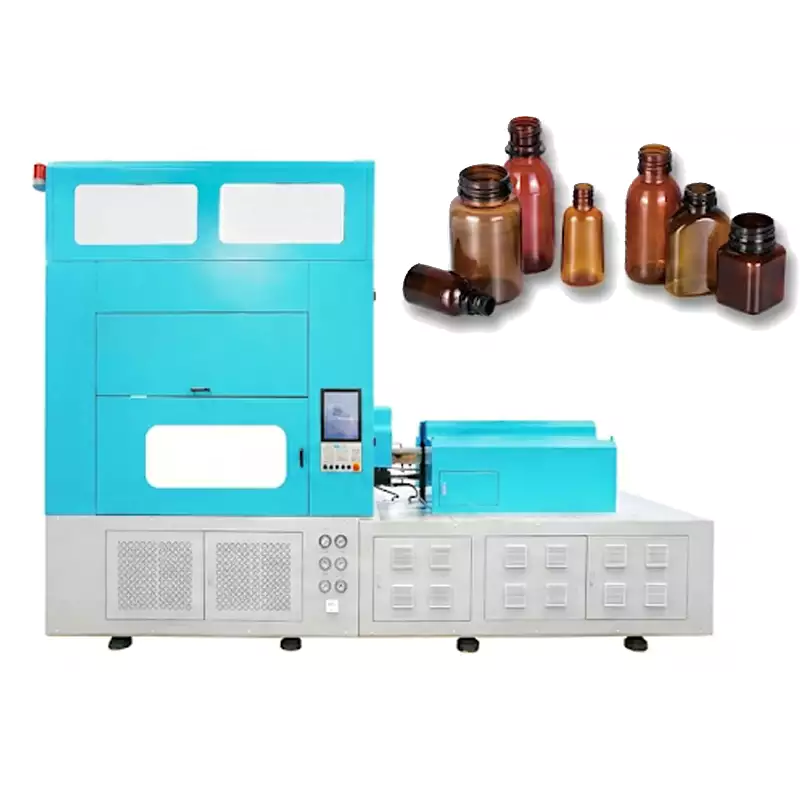
When translating the requirement into hardware, the HGY50-V3-EV machine configuration illustrates how injection, thermal conditioning, stretch-blow motion, and handling are organized on a compact one-step platform.
Questions that arise specifically in 3-Station vs 4-Station ISBM Machines Explained
Does a 4-station machine always make better bottles?
No. The extra conditioning stage can expand process control, but a simple container may not need it. Bottle geometry, resin and quality requirements determine the benefit.
Is a 3-station machine always cheaper to operate?
Not necessarily. Cost depends on machine design, cycle, utilities, tooling, maintenance and scrap. Fewer stations alone do not establish total cost.
What should I test in a machine trial?
Use the intended resin and a bottle that stresses the process window, then evaluate wall distribution, visual quality, dimensions, cycle stability and startup repeatability.
Can conditioning compensate for a poor preform design?
It can adjust thermal distribution, but it cannot remove fundamental limitations in preform geometry, stretch ratio or material quantity.
Which architecture is better for frequent changeovers?
Compare the number of parts changed, setup steps, recipe management and tool accessibility on the specific machines rather than relying on station count.
Practical conclusion
For 3-Station vs 4-Station ISBM Machines Explained, begin by documenting station sequence, then test tooling content without moving unrelated settings, and release the process only after decision test is verified on every active cavity. Headline station count is not a quality rating; process capability on the actual bottle is the useful measure.