How to Reduce ISBM Machine Cycle Time: Practical Technical Guide
This guide treats How to Reduce ISBM Machine Cycle Time as a sequence of measurable decisions. It begins with the physical product requirement, then tests the process mechanisms that can change the bottle, and finishes with a release condition that can be documented.
Baseline cycle mapInjection coolingValidation run
O que este artigo deve provar
Reduce cycle time systematically by finding the true limiting station, improving heat transfer and motion overlap, and validating bottle quality after each change instead of shortening every timer blindly. A defensible baseline begins with Record each station time, overlap and waiting period during stable automatic production. The first verification method is Use controller trends where available and confirm with production counts. From there, the article follows only checks that can materially change the answer promised by the title. Where an exact operating value depends on the resin grade, bottle drawing, mold, or delivered machine, the approved project specification controls the final setting.
✔️ Baseline cycle map
Record each station time, overlap and waiting period during stable automatic production. Use controller trends where available and confirm with production counts.
✔️ Limiting station
Identify the operation that actually determines when the machine can index. Change one component of that station and check whether total cycle responds.
✔️ Injection fill
Optimize fill profile to complete a balanced preform without excessive peak pressure or shear. Use process data, preform mass and visual quality while reducing only unnecessary time.
Measure the Existing Cycle Before Changing It
Baseline cycle map
Baseline cycle map. Record each station time, overlap and waiting period during stable automatic production. Use controller trends where available and confirm with production counts. Only shorten or intensify baseline cycle map when it is the true limiting operation and the bottle remains stable afterward. Use the smallest controlled change that can prove the effect of baseline cycle map, then restore the baseline before a different adjustment such as baseline cycle map is tried. A displayed cycle number alone does not reveal which station is waiting on another.
Para este tópico, o Portfólio de máquinas ISBM de uma etapa Fornece um contexto útil sobre os equipamentos para conectar os requisitos do processo a uma plataforma integrada de resina à garrafa.
Find the Longest Synchronized Operation
Limiting station
Limiting station. Identify the operation that actually determines when the machine can index. Change one component of that station and check whether total cycle responds. Only shorten or intensify limiting station when it is the true limiting operation and the bottle remains stable afterward. This factor belongs in the setup sheet because it directly changes the conditions under which limiting station is evaluated. Time removed from a non-limiting action simply becomes more waiting.
Injection fill
Injection fill. Optimize fill profile to complete a balanced preform without excessive peak pressure or shear. Use process data, preform mass and visual quality while reducing only unnecessary time. Only shorten or intensify injection fill when it is the true limiting operation and the bottle remains stable afterward. If the result differs by cavity, compare the local hardware related to injection fill before moving on to injection fill. An overly aggressive fill can create defects that appear later in the bottle.
Optimize Injection Fill, Pack and Recovery
Pack/hold
Pack/hold. Determine when additional hold time no longer changes preform mass or critical dimensions. Run a structured study instead of reducing hold until defects suddenly appear. Only shorten or intensify pack/hold when it is the true limiting operation and the bottle remains stable afterward. This item is considered resolved only when the finding remains repeatable after thermal stabilization and the next check, pack/hold, does not contradict it. Too little pack can lower mass or create sinks; excessive hold adds cycle without value.
Condições de trabalho para esta tarefa específica
- Baseline cycle map
- Record each station time, overlap and waiting period during stable automatic production.
- Limiting station
- Identify the operation that actually determines when the machine can index.
- Injection fill
- Optimize fill profile to complete a balanced preform without excessive peak pressure or shear.
- Pack/hold
- Determine when additional hold time no longer changes preform mass or critical dimensions.
Improve Preform and Mold Cooling
Screw recovery
Screw recovery. Ensure plasticizing completes before it blocks the next injection event. Review screw speed, back pressure, material condition and screw sizing with the supplier if recovery is long. Only shorten or intensify screw recovery when it is the true limiting operation and the bottle remains stable afterward. For repeatability, define who measures screw recovery, where it is measured, and what bottle evidence is required before checking screw recovery. Speeding recovery beyond the resin or screw capability can damage melt quality.
Injection cooling
Injection cooling. Improve water flow, circuit balance and mold contact before simply cutting cooling seconds. Look for fouling, trapped air or overly warm return water. Only shorten or intensify injection cooling when it is the true limiting operation and the bottle remains stable afterward. Record the bottle response beside the setting or measurement for injection cooling; that record becomes the starting condition when injection cooling is reviewed. A poor cooling circuit makes the process dependent on long dwell time.
| Item | Pergunta de engenharia | Verificação prática |
|---|---|---|
| Baseline cycle map | Record each station time, overlap and waiting period during stable automatic production. | Use controller trends where available and confirm with production counts. |
| Limiting station | Identify the operation that actually determines when the machine can index. | Change one component of that station and check whether total cycle responds. |
| Injection fill | Optimize fill profile to complete a balanced preform without excessive peak pressure or shear. | Use process data, preform mass and visual quality while reducing only unnecessary time. |
| Pack/hold | Determine when additional hold time no longer changes preform mass or critical dimensions. | Run a structured study instead of reducing hold until defects suddenly appear. |
| Screw recovery | Ensure plasticizing completes before it blocks the next injection event. | Review screw speed, back pressure, material condition and screw sizing with the supplier if recovery is long. |
| Injection cooling | Improve water flow, circuit balance and mold contact before simply cutting cooling seconds. | Look for fouling, trapped air or overly warm return water. |
| Condição de liberação | After optimization, run long enough to reach thermal equilibrium and sample all cavities. Confirm output, scrap, dimensions, wall distribution and utility stability before releasing the recipe. | |
Tune Conditioning without Losing Stretch Stability
Conditioning
Conditioning. When cycle shortens, re-establish the preform thermal profile using available heating/cooling zones. Compare temperature map and bottle thickness after each cycle change. Only shorten or intensify conditioning when it is the true limiting operation and the bottle remains stable afterward. If the symptom or performance target does not move as predicted, return conditioning to the baseline and investigate conditioning rather than stacking corrections. The old recipe may no longer have enough time to equalize heat.
O Visão geral da plataforma ISBM multimaterial Também ajuda a definir como a arquitetura da máquina, os materiais, os serviços públicos e as aplicações de garrafas se encaixam no nível da linha de produção.
Optimize Stretch-Blow and Ejection Motions
Blow and rod motions
Blow and rod motions. Optimize movement and air timing only after temperature and preform quality are stable. Use safe machine limits and preserve adequate time for complete forming and venting. Only shorten or intensify blow and rod motions when it is the true limiting operation and the bottle remains stable afterward. If a change improves one region but worsens another, compare the material or energy movement between blow and rod motions and blow and rod motions instead of accepting the first visual improvement. Shortening blow time can create poor definition or unstable base shape.
Remove Minor Stops that Hide behind Cycle Time
Ejection
Ejection. Check bottle release, gripper motion and downstream conveyor readiness. Remove avoidable delays but maintain sufficient bottle rigidity and clearance. Only shorten or intensify ejection when it is the true limiting operation and the bottle remains stable afterward. Where the outcome depends on material grade or tooling geometry, confirm the approved project limit and then use ejection as the next cross-check. A faster take-out that causes jams creates more lost time than it saves.
Minor stops
Minor stops. Analyze micro-stops, part sticking, material feed interruptions and alarm recovery. Track lost seconds per cause across a shift. Only shorten or intensify minor stops when it is the true limiting operation and the bottle remains stable afterward. When the project is near a machine or material limit, require a molding trial that isolates minor stops and then challenges minor stops under the same bottle specification. A one-second faster cycle is irrelevant if repeated small stops consume minutes each hour.
Validate the New Cycle as a Production Process
Validation run
Validation run. After optimization, run long enough to reach thermal equilibrium and sample all cavities. Confirm output, scrap, dimensions, wall distribution and utility stability before releasing the recipe. Only shorten or intensify validation run when it is the true limiting operation and the bottle remains stable afterward. The safest interpretation comes from comparing at least several stable cycles and then verifying validation run without changing the rest of the recipe. A record cycle demonstrated for a few minutes may not be a sustainable production cycle.
Minor stops: release evidence
Analyze micro-stops, part sticking, material feed interruptions and alarm recovery. Track lost seconds per cause across a shift. The condition is accepted only when the relevant bottle measurement or functional test remains stable after the process reaches normal operating temperature.
Validation run: failure boundary
A record cycle demonstrated for a few minutes may not be a sustainable production cycle. Use that failure mode as the boundary for the trial and return to the previous stable condition when the bottle response moves in the wrong direction.
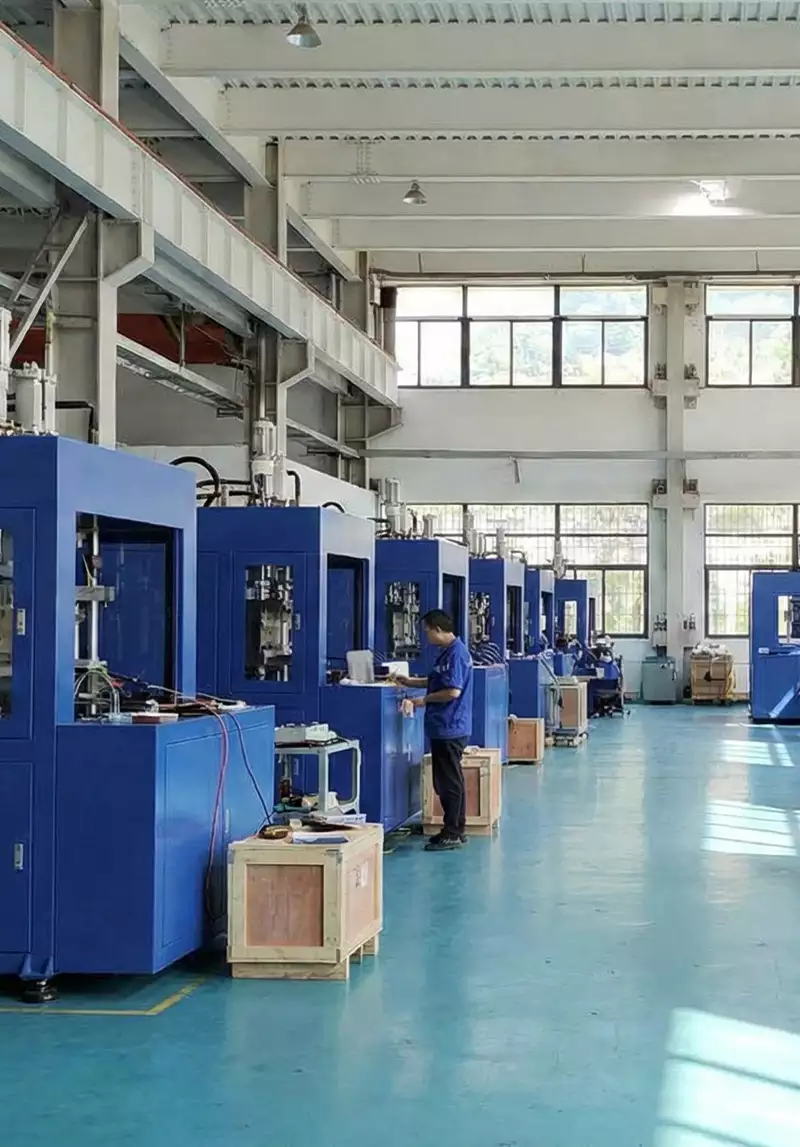
Ao traduzir o requisito em hardware, o Configuração da máquina HGY50-V3-EV Ilustra como a injeção, o condicionamento térmico, o movimento de estiramento e sopro e o manuseio são organizados em uma plataforma compacta de uma única etapa.
Questions that arise specifically in How to Reduce ISBM Machine Cycle Time
What should I shorten first?
Shorten the operation that truly limits the synchronized cycle, not the timer that is easiest to change.
Why can reducing cycle time change wall thickness?
The preform has less time to cool and equalize, changing its thermal profile when stretching begins.
Can a faster screw speed always reduce cycle?
Only if screw recovery is the bottleneck and melt quality remains acceptable. Excessive plasticizing speed can increase shear or instability.
How do minor stops affect cycle improvement?
They reduce actual output even if the nominal cycle is fast. OEE-style loss analysis often finds larger gains in stability than in timer reduction.
When is cycle optimization complete?
When further time reduction would reduce quality, process margin, equipment reliability or downstream stability more than it improves good output.
Conclusão prática
For How to Reduce ISBM Machine Cycle Time, begin by documenting baseline cycle map, then test injection cooling without moving unrelated settings, and release the process only after validation run is verified on every active cavity. A record cycle demonstrated for a few minutes may not be a sustainable production cycle.