
How to Scale ISBM Production Without Losing Quality: Practical Technical Guide
For How to Scale ISBM Production Without Losing Quality, the objective is not to find one universal setting. It is to prove which combination of quality baseline, injection throughput, and standard work produces the required bottle under stable factory conditions.
Quality baselineDrying capacityFull-load qualification
What this article must prove
Scale from development or low-volume isbm to higher output without losing wall distribution, appearance, dimensional capability or process stability by treating scale-up as a new system validation. A defensible baseline begins with Define the approved bottle weight, wall map, dimensions, visual limits and functional tests from the current process. The first verification method is Use this as the scale-up comparison set. From there, the article follows only checks that can materially change the answer promised by the title. Where an exact operating value depends on the resin grade, bottle drawing, mold, or delivered machine, the approved project specification controls the final setting.

✔️ Quality baseline
Define the approved bottle weight, wall map, dimensions, visual limits and functional tests from the current process. Use this as the scale-up comparison set.
✔️ Scale path
Compare higher cavitation, shorter cycle, parallel machines and longer campaigns. Model tooling, utilities, labor, risk and SKU flexibility for each path.
✔️ Injection throughput
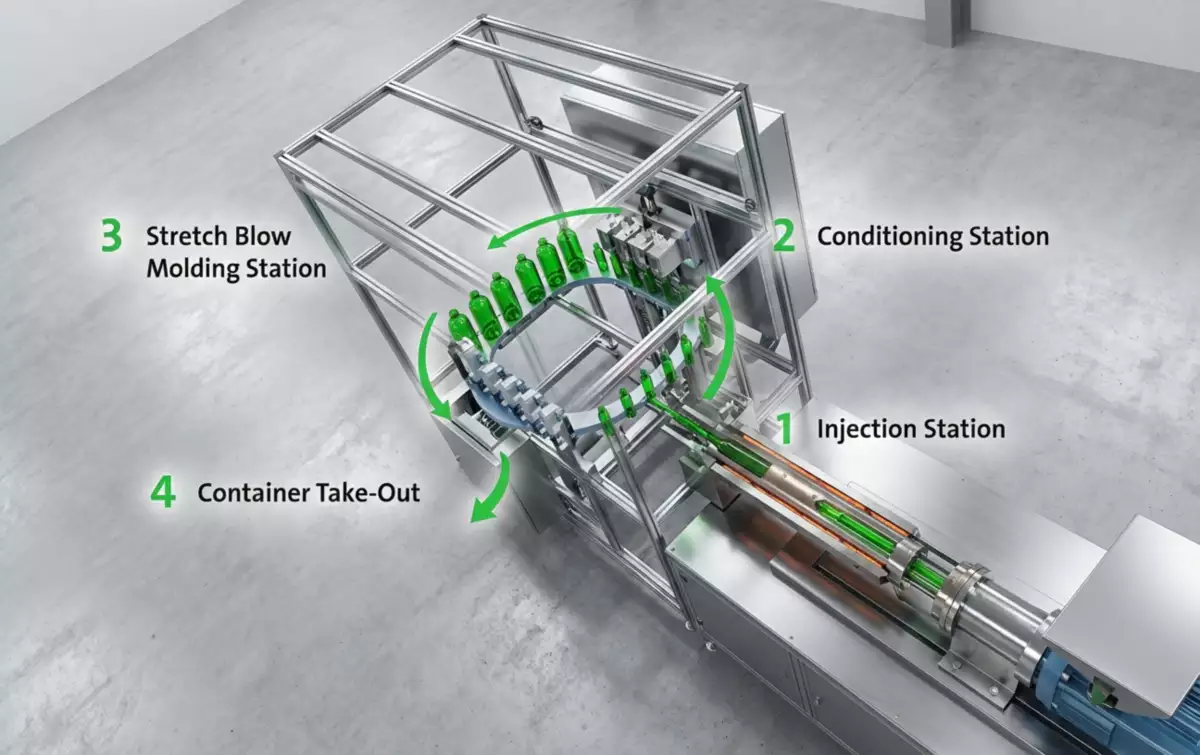
Higher cavities or shorter cycles increase resin kg/h and screw recovery demand. Check shot utilization, plasticizing time and melt residence at the new condition.
The multi-material ISBM platform overview also helps frame how machine architecture, materials, utilities, and bottle applications fit together at line level.
Freeze the Quality Standard before Adding Output
Quality baseline
Quality baseline. Define the approved bottle weight, wall map, dimensions, visual limits and functional tests from the current process. Use this as the scale-up comparison set. Revalidate quality baseline under the expanded line load because scaling changes utilities, heat flow, and cavity interactions. Where the outcome depends on material grade or tooling geometry, confirm the approved project limit and then use quality baseline as the next cross-check. Without a frozen baseline, quality can drift gradually while output improves.
Decide Whether to Add Cavities, Speed or Machines
Scale path
Scale path. Compare higher cavitation, shorter cycle, parallel machines and longer campaigns. Model tooling, utilities, labor, risk and SKU flexibility for each path. Revalidate scale path under the expanded line load because scaling changes utilities, heat flow, and cavity interactions. When the project is near a machine or material limit, require a molding trial that isolates scale path and then challenges scale path under the same bottle specification. The cheapest way to add nominal capacity may be the most fragile for a high-mix plant.
Recheck Injection and Cooling at Higher Throughput
Injection throughput
Injection throughput. Higher cavities or shorter cycles increase resin kg/h and screw recovery demand. Check shot utilization, plasticizing time and melt residence at the new condition. Revalidate injection throughput under the expanded line load because scaling changes utilities, heat flow, and cavity interactions. The safest interpretation comes from comparing at least several stable cycles and then verifying injection throughput without changing the rest of the recipe. A process that was comfortably inside the injection window can become recovery-limited.
Cooling load
Cooling load. More resin per hour means more heat removed from molds and machine. Recalculate chiller and water distribution with simultaneous factory load. Revalidate cooling load under the expanded line load because scaling changes utilities, heat flow, and cavity interactions. A useful production trial keeps the resin lot and cavity identification fixed while cooling load is changed, followed by a separate check of cooling load. Cooling drift often appears only after all production lines run together.
Working terms for this specific task
- Quality baseline
- Define the approved bottle weight, wall map, dimensions, visual limits and functional tests from the current process.
- Scale path
- Compare higher cavitation, shorter cycle, parallel machines and longer campaigns.
- Injection throughput
- Higher cavities or shorter cycles increase resin kg/h and screw recovery demand.
- Cooling load
- More resin per hour means more heat removed from molds and machine.
Recheck Blow-Air Peak Demand
Air demand
Air demand. Higher output increases blow events and may increase simultaneous peak demand. Measure machine pressure during full-plant production. Revalidate air demand under the expanded line load because scaling changes utilities, heat flow, and cavity interactions. The practical value of this check is that it turns air demand from a vague setting into evidence that can be compared with air demand. Scale-up trials on an isolated machine can hide header pressure collapse.
| Елемент | Engineering question | Practical verification |
|---|---|---|
| Quality baseline | Define the approved bottle weight, wall map, dimensions, visual limits and functional tests from the current process. | Use this as the scale-up comparison set. |
| Scale path | Compare higher cavitation, shorter cycle, parallel machines and longer campaigns. | Model tooling, utilities, labor, risk and SKU flexibility for each path. |
| Injection throughput | Higher cavities or shorter cycles increase resin kg/h and screw recovery demand. | Check shot utilization, plasticizing time and melt residence at the new condition. |
| Cooling load | More resin per hour means more heat removed from molds and machine. | Recalculate chiller and water distribution with simultaneous factory load. |
| Air demand | Higher output increases blow events and may increase simultaneous peak demand. | Measure machine pressure during full-plant production. |
| Drying capacity | Resin preparation must increase in kg/h while preserving required residence and air condition. | Check hopper inventory, dryer capacity and conveying rate. |
| Release condition | Run the expanded system with normal compressors, chillers, dryers and downstream equipment operating simultaneously. Measure good output, utilities, scrap and quality over a sustained period. | |
Protect Material Preparation as Resin Flow Increases
Drying capacity
Drying capacity. Resin preparation must increase in kg/h while preserving required residence and air condition. Check hopper inventory, dryer capacity and conveying rate. Revalidate drying capacity under the expanded line load because scaling changes utilities, heat flow, and cavity interactions. Use this result to narrow the process window, not to create a new universal setpoint; the next constraint to confirm is drying capacity. The molding machine may wait for material or receive under-dried resin at higher throughput.
A demanding shape case such as the wide-mouth container ISBM application is useful for checking whether the same process logic remains stable when projected area, heat balance, and material distribution become harder to control.
Preserve Cavity-to-Cavity Quality
Cavity quality
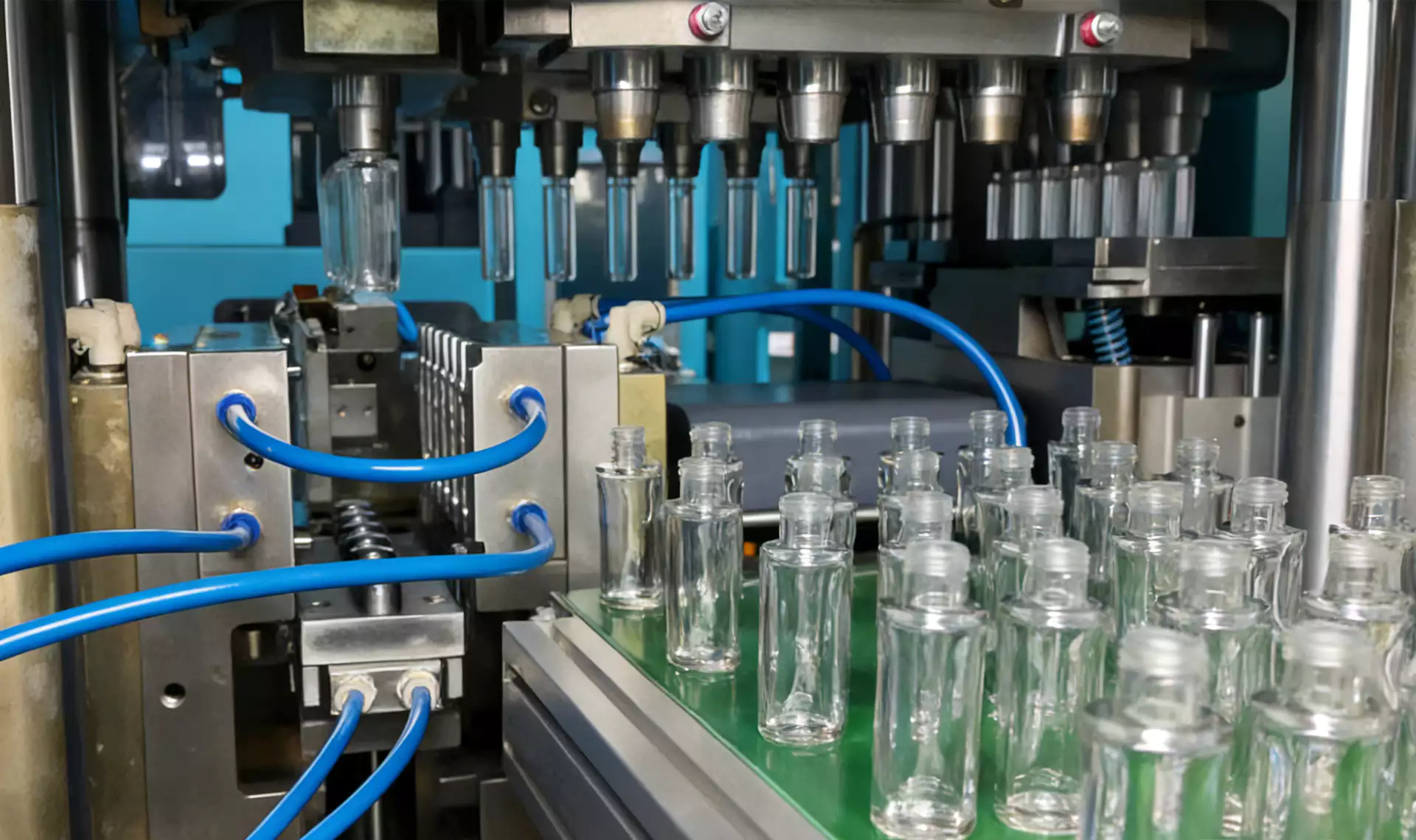
Cavity quality. More cavities increase the chance of local hot-runner, cooling, rod or air differences. Use cavity-level weight, wall and defect data. Revalidate cavity quality under the expanded line load because scaling changes utilities, heat flow, and cavity interactions. The expected response should be visible in a bottle measurement, defect map, or machine trend before the team proceeds to cavity quality. A batch average becomes less informative as cavitation increases.
Process window
Process window. Do not simply run the old recipe faster; cycle changes alter preform thermal history. Re-tune conditioning and verify thickness after each speed step. Revalidate process window under the expanded line load because scaling changes utilities, heat flow, and cavity interactions. Once this check is stable, the next useful question is whether process window changes the same bottle region or affects a different part of the process. A recipe can cross from robust to sensitive as heat-equalization time decreases.
Standardize Recipes, Changeovers and Maintenance
Standard work
Standard work. Document startup, changeover, golden sample, quality reaction and maintenance procedures before multiplying equipment. Train operators and technicians on the same diagnostic sequence. Revalidate standard work under the expanded line load because scaling changes utilities, heat flow, and cavity interactions. This checkpoint should be evaluated before standard work is altered, because otherwise two process mechanisms change at the same time. Scaling a process that depends on one expert creates operational bottlenecks.
Qualify the Expanded Line under Full Factory Load
Full-load qualification
Full-load qualification. Run the expanded system with normal compressors, chillers, dryers and downstream equipment operating simultaneously. Measure good output, utilities, scrap and quality over a sustained period. Revalidate full-load qualification under the expanded line load because scaling changes utilities, heat flow, and cavity interactions. For this topic, the engineering log should connect full-load qualification with the observed bottle condition and then test whether full-load qualification supports the same diagnosis. A successful single-machine trial is not proof that the factory infrastructure can support the expanded line.
Standard work: release evidence
Document startup, changeover, golden sample, quality reaction and maintenance procedures before multiplying equipment. Train operators and technicians on the same diagnostic sequence. The condition is accepted only when the relevant bottle measurement or functional test remains stable after the process reaches normal operating temperature.
Full-load qualification: failure boundary
A successful single-machine trial is not proof that the factory infrastructure can support the expanded line. Use that failure mode as the boundary for the trial and return to the previous stable condition when the bottle response moves in the wrong direction.
The ASB-compatible tooling configuration is also relevant when checking how mold interfaces and machine motion must remain compatible during replacement, troubleshooting, or capacity changes.
Questions that arise specifically in How to Scale ISBM Production Without Losing Quality
Should I scale by adding cavities or buying another machine?
Compare output, tooling, flexibility, utility load, maintenance risk and SKU mix. There is no universal answer.
Why can quality change when cycle time is shortened?
The preform and bottle spend less time cooling and conditioning, changing the thermal state at stretching and ejection.
What utility usually appears as a scale-up bottleneck?
High-pressure air, cooling and drying can all become limiting, especially when multiple machines peak together.
How do I preserve quality across more cavities?
Use cavity-level process and quality data, balanced cooling and air delivery, and disciplined mold maintenance.
When is scale-up complete?
When the expanded line sustains required good output and all bottle specifications under normal full-factory utility and staffing conditions.
Practical conclusion
The final decision on How to Scale ISBM Production Without Losing Quality is made by the bottle, not by a single displayed parameter. Use quality baseline to establish the input, drying capacity to test the mechanism, and full-load qualification to prove the output under stable conditions. A successful single-machine trial is not proof that the factory infrastructure can support the expanded line.