
How to Produce Wide-Mouth Jars with ISBM: Practical Technical Guide
The useful answer to How to Produce Wide-Mouth Jars with ISBM comes from the interaction between mouth diameter, pre-blow, and closure validation. The sections below turn those factors into checks that can be repeated on a production machine.
Mouth diameterVoorblazenClosure validation
Wat dit artikel moet bewijzen
Produce wide-mouth jars by solving the geometry, neck cooling, lip-cavity pitch, preform mass distribution, stretch path, base cooling and ejection issues that become more demanding as the finish diameter increases. A defensible baseline begins with Record thread or snap finish diameter, sealing land, support ring and closure engagement. The first verification method is Lay out the neck components at cavity pitch before selecting cavitation. From there, the article follows only checks that can materially change the answer promised by the title. Where an exact operating value depends on the resin grade, bottle drawing, mold, or delivered machine, the approved project specification controls the final setting.
✔️ Mouth diameter
Record thread or snap finish diameter, sealing land, support ring and closure engagement. Lay out the neck components at cavity pitch before selecting cavitation.
✔️ Jar aspect ratio
Wide jars can have relatively short stretch length compared with body diameter. Calculate directional stretch and verify that the preform can move material to the lower wall before radial expansion completes.
✔️ Voer de massa uit
Distribute enough resin for the broad shoulder, sidewall and base without creating a thick hot core. Use preform profiling and molding trials rather than simply increasing total mass.
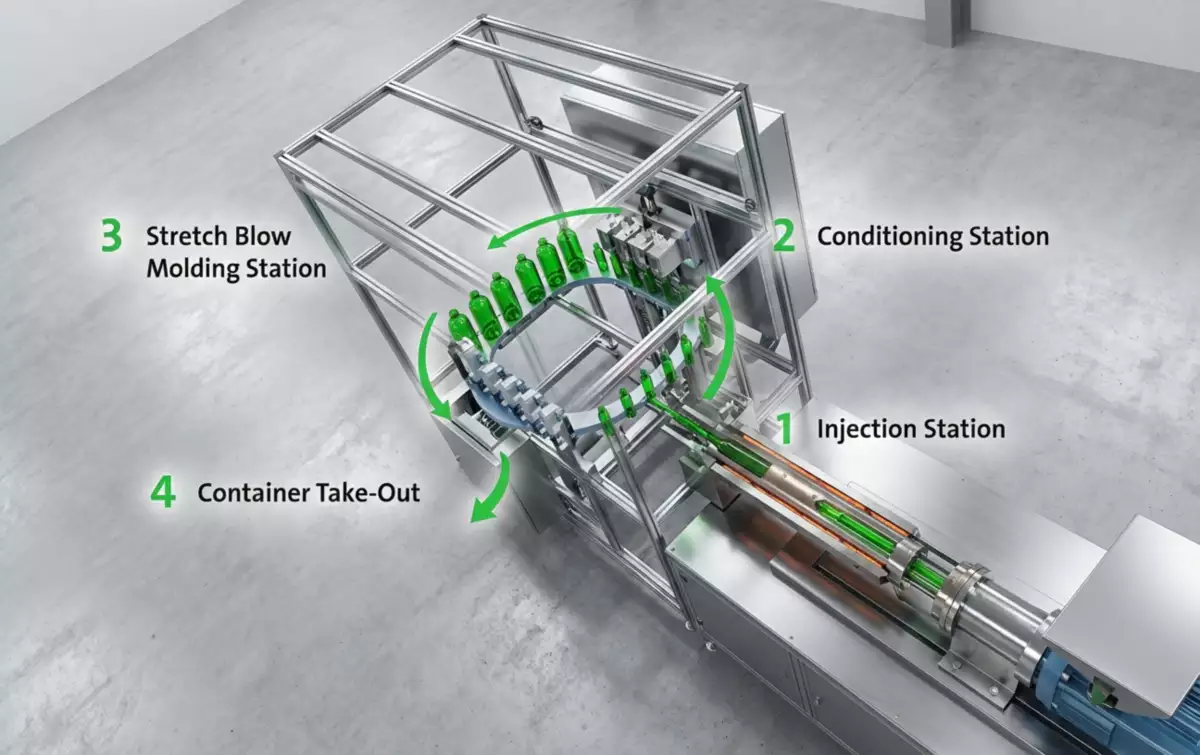
Voor dit onderwerp, de ISBM-machineportfolio met éénstapsbediening Biedt nuttige context voor de apparatuur om de procesvereisten te koppelen aan een geïntegreerd platform van hars tot fles.
Step 1: Define the Wide-Mouth Finish and Jar Envelope
Mouth diameter
Mouth diameter. Record thread or snap finish diameter, sealing land, support ring and closure engagement. Lay out the neck components at cavity pitch before selecting cavitation. The step is complete only when mouth diameter produces the expected condition and the machine can proceed safely to the following operation. This item is considered resolved only when the finding remains repeatable after thermal stabilization and the next check, mouth diameter, does not contradict it. A wide finish can reduce cavity count even if jar body diameter appears to fit.
Step 2: Check Lip-Cavity Pitch and Machine Space
Jar aspect ratio
Jar aspect ratio. Wide jars can have relatively short stretch length compared with body diameter. Calculate directional stretch and verify that the preform can move material to the lower wall before radial expansion completes. The step is complete only when jar aspect ratio produces the expected condition and the machine can proceed safely to the following operation. For repeatability, define who measures jar aspect ratio, where it is measured, and what bottle evidence is required before checking jar aspect ratio. Too much early radial blow can leave a heavy shoulder and thin heel.
Step 3: Design a Preform that Feeds the Shoulder and Base
Voorvorm massa
Voorvorm massa. Distribute enough resin for the broad shoulder, sidewall and base without creating a thick hot core. Use preform profiling and molding trials rather than simply increasing total mass. The step is complete only when preform mass produces the expected condition and the machine can proceed safely to the following operation. Record the bottle response beside the setting or measurement for preform mass; that record becomes the starting condition when preform mass is reviewed. An excessively heavy preform can lengthen injection cooling and destabilize the one-step thermal cycle.
Finish cooling
Finish cooling. The mouth should remain dimensionally stable while the body reaches a stretchable temperature. Use neck/lip cooling and shielding features available on the machine and verify closure dimensions after stable production. The step is complete only when finish cooling produces the expected condition and the machine can proceed safely to the following operation. If the symptom or performance target does not move as predicted, return finish cooling to the baseline and investigate finish cooling rather than stacking corrections. Finish ovality or thread distortion causes capping problems that may not be visually obvious.
Werkvoorwaarden voor deze specifieke taak
- Mouth diameter
- Record thread or snap finish diameter, sealing land, support ring and closure engagement.
- Jar aspect ratio
- Wide jars can have relatively short stretch length compared with body diameter.
- Voorvorm massa
- Distribute enough resin for the broad shoulder, sidewall and base without creating a thick hot core.
- Finish cooling
- The mouth should remain dimensionally stable while the body reaches a stretchable temperature.
Step 4: Protect the Finish during Conditioning
Rekstang
Rekstang. Short, wide jars provide less axial travel for distributing material. Set rod contact and speed so the base material is established before full radial expansion. The step is complete only when stretch rod produces the expected condition and the machine can proceed safely to the following operation. If a change improves one region but worsens another, compare the material or energy movement between stretch rod and stretch rod instead of accepting the first visual improvement. A rod that arrives late can leave the base starved; excessive speed can create local stress or gate issues.
| Item | Technische vraag | Praktische verificatie |
|---|---|---|
| Mouth diameter | Record thread or snap finish diameter, sealing land, support ring and closure engagement. | Lay out the neck components at cavity pitch before selecting cavitation. |
| Jar aspect ratio | Wide jars can have relatively short stretch length compared with body diameter. | Calculate directional stretch and verify that the preform can move material to the lower wall before radial expansion completes. |
| Voorvorm massa | Distribute enough resin for the broad shoulder, sidewall and base without creating a thick hot core. | Use preform profiling and molding trials rather than simply increasing total mass. |
| Finish cooling | The mouth should remain dimensionally stable while the body reaches a stretchable temperature. | Use neck/lip cooling and shielding features available on the machine and verify closure dimensions after stable production. |
| Rekstang | Short, wide jars provide less axial travel for distributing material. | Set rod contact and speed so the base material is established before full radial expansion. |
| Voorblazen | Use pre-blow timing to prevent the preform from sticking to the rod while preserving axial draw. | Change timing incrementally and compare shoulder/sidewall/base thickness. |
| Vrijgavevoorwaarde | Test cap engagement, seal, torque, leak and top load with the intended closure system. Run aging or thermal tests required by the package. | |
Step 5: Control Axial Stretch with a Short, Wide Preform
Voorblazen
Vooraf blazen. Use pre-blow timing to prevent the preform from sticking to the rod while preserving axial draw. Change timing incrementally and compare shoulder/sidewall/base thickness. The step is complete only when pre-blow produces the expected condition and the machine can proceed safely to the following operation. Where the outcome depends on material grade or tooling geometry, confirm the approved project limit and then use pre-blow as the next cross-check. An early large bubble can lock the shoulder before material reaches the lower jar.
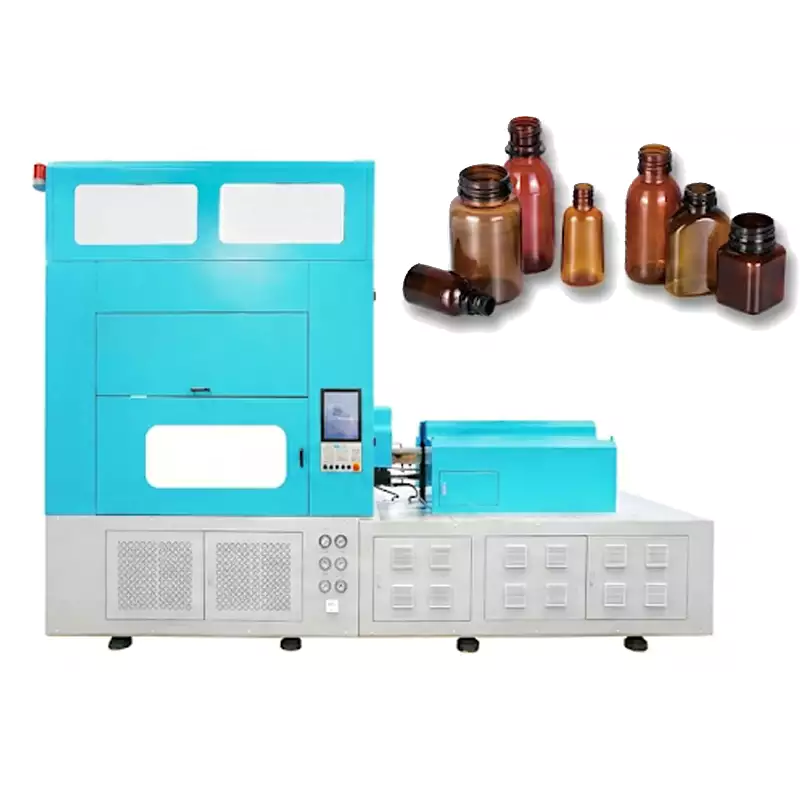
Bij het vertalen van de vereisten naar hardware, de HGY50-V3-EV machineconfiguratie Het illustreert hoe injectie, thermische conditionering, rek-blaasbeweging en handling georganiseerd zijn op een compact platform met één bewerkingsstap.
Step 6: Tune Radial Expansion and Venting
Ventilatie
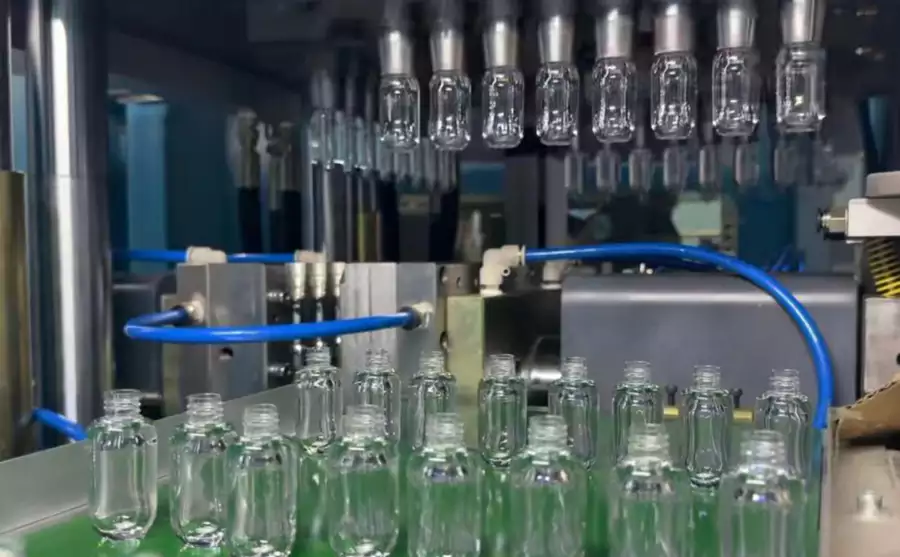
Ventileren. Large surface area reaches the mold quickly and air must escape from corners, ribs and base features. Keep parting-line and local vents clean and inspect poor detail before increasing pressure. The step is complete only when venting produces the expected condition and the machine can proceed safely to the following operation. When the project is near a machine or material limit, require a molding trial that isolates venting and then challenges venting under the same bottle specification. Trapped air can create dull patches or incomplete embossing.
Base cooling
Base cooling. Wide bases can retain heat and are sensitive to rocking or dish deformation. Check base insert water flow and measure flatness after the jar stabilizes. The step is complete only when base cooling produces the expected condition and the machine can proceed safely to the following operation. The safest interpretation comes from comparing at least several stable cycles and then verifying base cooling without changing the rest of the recipe. A jar that stands flat immediately may warp after filling if the base leaves the mold too hot.
Step 7: Cool the Base and Mouth before Ejection
Uitstoting
Uitstoting. Large mouths and short bodies can stick or flex during take-out. Tune release, opening stroke and gripper support so the jar is not squeezed while warm. The step is complete only when ejection produces the expected condition and the machine can proceed safely to the following operation. A useful production trial keeps the resin lot and cavity identification fixed while ejection is changed, followed by a separate check of ejection. Mechanical handling can distort a correctly molded finish.
Step 8: Verify Closure, Top Load and Standing Stability
Closure validation
Closure validation. Test cap engagement, seal, torque, leak and top load with the intended closure system. Run aging or thermal tests required by the package. The step is complete only when closure validation produces the expected condition and the machine can proceed safely to the following operation. The practical value of this check is that it turns closure validation from a vague setting into evidence that can be compared with closure validation. Molding dimensions alone do not prove package function.
Ejection: release evidence
Large mouths and short bodies can stick or flex during take-out. Tune release, opening stroke and gripper support so the jar is not squeezed while warm. The condition is accepted only when the relevant bottle measurement or functional test remains stable after the process reaches normal operating temperature.
Closure validation: failure boundary
Molding dimensions alone do not prove package function. Use that failure mode as the boundary for the trial and return to the previous stable condition when the bottle response moves in the wrong direction.
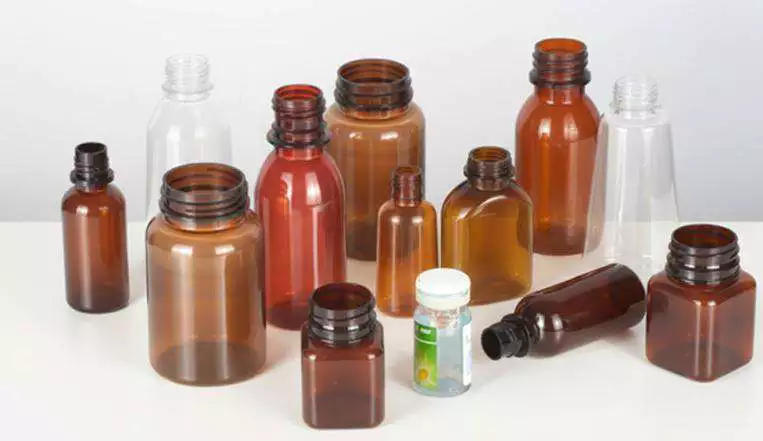
Een veeleisende vormcase zoals de toepassing van ISBM-containers met brede opening Dit is nuttig om te controleren of dezelfde proceslogica stabiel blijft wanneer het geprojecteerde oppervlak, de warmtebalans en de materiaalverdeling moeilijker te beheersen worden.
Questions that arise specifically in How to Produce Wide-Mouth Jars with ISBM
Why do wide-mouth jars often have fewer cavities?
The lip/neck components and jar body require more pitch, which can control mold size before shot capacity does.
Why is the base difficult on a short jar?
The process has less axial distance to move material before radial expansion, so preform design and stretch/blow timing are critical.
Can higher blow pressure fix a thin heel?
Usually not by itself. Thin-heel problems are more directly tied to preform material distribution, temperature and stretch/pre-blow timing.
Why does a jar rock after cooling?
The base may have left the mold too hot or cooled unevenly, allowing post-ejection relaxation or warpage.
What should be measured first?
Start with the closure-critical finish, then wall distribution, base flatness and dimensions that affect filling and labeling.
Praktische conclusie
A robust answer to How to Produce Wide-Mouth Jars with ISBM should survive a restart and a full thermal stabilization period. The setup record should therefore connect mouth diameter with pre-blow and the bottle result from closure validation. An early large bubble can lock the shoulder before material reaches the lower jar.